
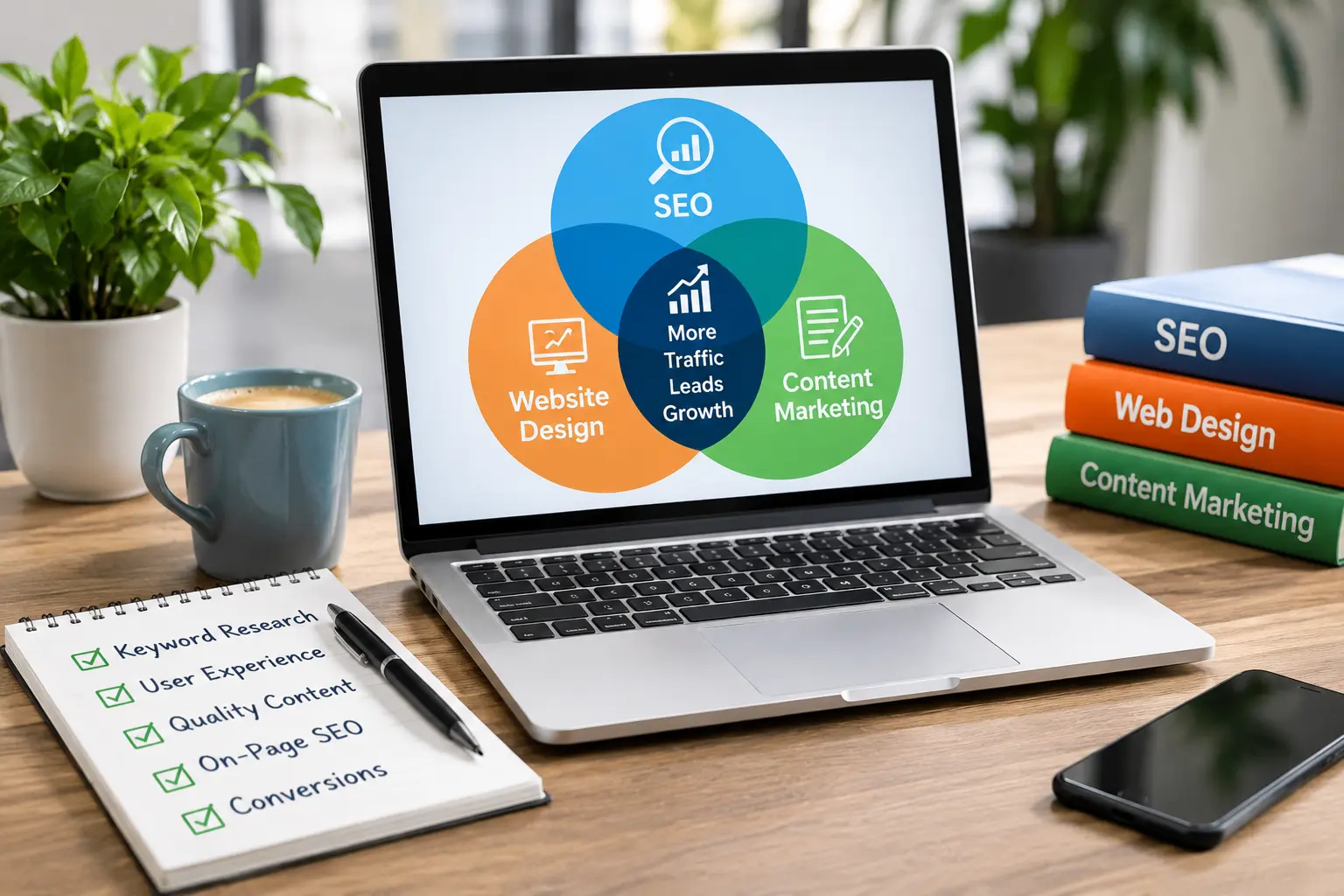
A business website can look polished yet struggle to attract visitors. It can also rank for relevant searches but fail to turn visits into enquiries. These problems often arise when website design, SEO, and content marketing are planned as separate activities.
For businesses comparing Web Design Melbourne providers, the important question is how these disciplines will work together before launch and as the website grows. Each has a distinct role, but the strongest results come from coordinating them around the same audience, goals, and customer journey.
How the Three Disciplines Support One Another
Website design creates the structure and user experience
Website design determines how information is organised and how visitors move through the site. Navigation, page layouts, mobile usability, accessibility, and calls to action all affect whether people can find what they came for.
Design also influences how search engines access and interpret a website. Clear page structure, descriptive headings, crawlable links, and accessible text help users and search systems understand the content. Google’s developer guidance for search-friendly websites covers these technical and structural considerations.
Design should therefore begin with more than colours and visual style. It should reflect the pages visitors require, the questions they ask, and the actions the business wants them to take.
SEO helps the right audience find relevant pages
SEO connects a website’s pages with the searches people make. It includes understanding search intent, mapping topics to pages, improving technical accessibility, and making page content relevant to users’ queries.
SEO works best when it informs the website structure early. For example, keyword and intent research can reveal that a business should have separate service pages rather than placing every offering on one broad page.
A coordinated SEO Services Melbourne strategy can also identify content gaps, internal-link opportunities, and pages that require improvement. These insights help guide both the site’s structure and its ongoing content plan.
Content answers questions and supports decisions
Content gives each page a purpose. Service pages explain what a business offers, supporting articles answer broader questions, and useful FAQs clarify details that may affect a buying decision.
Content marketing extends that work by planning, publishing, and distributing information for the intended audience. SEO research helps identify topics and search intent; content makes those topics useful; and website design presents the information in a format people can navigate.
The relationship is ongoing. Search data can reveal questions that deserve new content, while content performance can highlight pages that require better structure or clearer calls to action.
What Does Their Collaboration Look Like in Practice?
Before the website is built
Start by defining the audience, business goals, and key actions, such as enquiries, bookings, or purchases. Then:
- Research the searches and questions relevant to the business.
- Map each priority topic to a suitable page.
- Plan navigation and internal links around those pages.
- Identify the information visitors require before taking action.
- Set measurable goals for visibility and conversions.
This prevents the site structure from being decided before the content and SEO requirements are understood.
During design and development
Designers, developers, SEO specialists, and content writers should work from the same page plan. Each important page should have a clear purpose, useful content, descriptive headings, and a logical next step.
The development process should also account for mobile usability, page loading, crawlability, indexability, redirects where relevant, and accessible text. Google recommends evaluating overall page quality rather than focusing on a single technical metric. Its page experience guidance explains the broader considerations.
After launch
Launching the website is the start of its improvement cycle. Review how visitors find and use the pages, which searches bring relevant traffic, and whether users complete important actions.
Use the findings to update content, improve navigation, refine calls to action, address technical issues, and create supporting pages where genuine gaps exist.
What Happens When They Are Managed Separately?
When SEO is added only after design is complete, important pages may be missing or difficult to reach. When content is produced without a page strategy, similar articles can compete for the same topic or remain disconnected from service pages.
A visually attractive site may also leave visitors uncertain about what the business offers or how to contact it. Conversely, a page that attracts search traffic may underperform if it does not answer the visitor’s question clearly.
These are coordination problems, not proof that one discipline is more important than the others.
A Practical Checklist for Businesses
Before approving a new website or major redesign, confirm that:
- The target audience and primary business goals are documented.
- Search intent has informed the page structure.
- Each important page has a clear topic and purpose.
- Content is planned before layouts are finalised.
- Navigation and internal links connect related pages.
- Mobile usability and technical SEO are included in testing.
- Calls to action match the page’s purpose.
- Analytics can measure relevant enquiries or sales.
- There is a plan for reviewing and improving the site after launch.
How to Measure Whether They Are Working Together
Use a combination of measures rather than relying on one number:
- Search visibility: relevant impressions, clicks, and landing-page performance.
- Content usefulness: engagement with key pages and whether visitors move to relevant next steps.
- Conversion outcomes: enquiries, bookings, purchases, or other meaningful actions.
- Technical health: crawlability, indexability, mobile usability, and performance issues.
Google’s people-first content guidance recommends creating useful content for an intended audience rather than producing pages primarily to attract search traffic. That principle applies across the website: design, SEO, and content should serve the same visitor.
Frequently Asked Questions
Does SEO start before website design?
Yes. SEO research can inform the site structure, page topics, navigation, and content requirements before design begins. Technical and content checks should continue during development and after launch.
Can website design affect SEO?
Yes. Site structure, mobile usability, page performance, accessible content, and crawlable links can affect how people use a site and how search engines access its pages.
Is content marketing part of SEO?
They overlap but are not identical. SEO helps connect pages with relevant searches, while content marketing plans and distributes useful information to an audience. Coordinating them helps content support both discovery and business goals.
Which should a business prioritise first?
Start with the audience, business goals, and search intent. Use those findings to plan the website structure, content, and technical requirements together rather than treating one discipline as a standalone first step.
Bringing the Three Together
SEO helps people find relevant pages, website design makes those pages accessible and easy to use, and content gives visitors useful answers. When these disciplines share a plan, a website can support both search visibility and meaningful business actions.
Businesses planning a new website or improving an existing one can review their design and SEO requirements together. Sales On Sky provides web design and development and SEO growth marketing services for businesses in Melbourne. To discuss a project, use the website’s quote or contact options.